In recent years, front-end development technology has dramatically changed. Simple HTML, CSS, and JavaScript combination have now been replaced by more comprehensive front-end frameworks and libraries such as Angular (created by Google) and React (developed by Facebook). They are here to stay and becoming the dominant standard now.
But given the rise of new capabilities in Angular and React there is still a lot of confusion around which front-end development framework and/or library to choose while building your next web app.
While you are making that decision, here are some data points for your consideration and to help you make the right choice for your project. The data points below are more from the library-based approach or React perspective.
First thing first – React as a library
React is an open-source JavaScript library created by Facebook in 2011 for building dynamic user interfaces. Based on JavaScript and JSX, it focuses on building reusable components for front-end layer. React is used by Facebook, Instagram, Netflix, Uber, Twitter, Udemy, Reddit, Airbnb, Walmart, and the list is growing fast. It also has a separate cross-platform framework for mobile development that is called React Native.
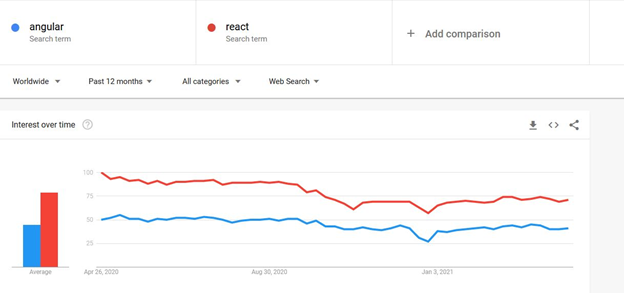
Here is a quick fact-check on the usage growth. As per Google trend, React’s popularity has grown significantly over the last few years.
When should you consider React?
Think of a scenario wherein you would like to modernize your existing website and give the users a snazzier experience. In the modern web development world, you often offload much of the UI responsibilities on the browser and these can be categorized as SPA (Single Page Applications). The challenge though is that your existing project code is not very supportive of this new style of coding. This forces you to add an extra piece of code to get the job done, which, more often than not, is just a temporary fix and unnecessary overhead. In many cases, you may also be required to restructure the application because next-level business requirements may break the fragile UI.
React attempts to solve these problems for you by giving you the capabilities to:
- Break your complex application into smaller components and help you transition into a SPA or cross-platform applications with rich set of features at your own pace
- Create large scale UI with data that can be refactored over time effortlessly
- Individually develop and scale components of the apps that demand high security and performance under the heaviest load
- Decouple larger enterprise-grade applications into modern light-weight components
How React has the edge over frameworks
React gives you complete freedom to choose the tools, architecture, and libraries for developing an app. Three key factors that provide React the edge over other front-end frameworks are its Flexibility, Performance, and capability to Future-Proof the app. Let us look at each in detail.
Tremendous Flexibility
React is a component-based library, which makes it completely flexible. As a library, it can be paired with almost any other JS library or framework. This gives you the flexibility to change any component at any point of time without effecting the other parts of the application because React’s data flow & state management mechanism helps in abstracting an individual components state from each other. This is quite handy when you need to develop complex and real-time applications where data changes spontaneously and needs to be orchestrated across multiple components simultaneously.
React gives enough flexibility to pack it with other programming libraries, which facilitate and accelerate the development process. You can reuse components on any platform that gives it a considerable advantage.
All the flexibility is possible because React is not an opinionated library. You can use different JS libraries the way you want and develop individual aspects independently. For e.g., React can be used along with redux, backbone, handlebar, etc. As compared to frameworks, the conventions that are required to follow are relaxed.
Flexibility Impact
- Significantly reduce developers’ coding time and, thus, the project costs
- Componentized development makes testing easier & more effective
- Easier management of updates and modifications
Amazing Performance
React seems to have the edge over front-end frameworks like Angular.js in runtime performance due to the virtual Document Object Model (DOM). Virtual DOM is built on a server and very lightweight, thus enabling faster rendering. It allows you to manage the code according to your desired format. It gives you an option to choose without putting any performance penalty. Developers can spend more time writing modern JavaScript, and less time worrying about the framework-specific code. When you combine with ES6/7, React is perfect for managing heavy loads with relative ease.
Check out what Netflix developers have to say about their experience with React’s performance while refactoring their UX for the site.
Performance Impact
- Startup speed for the SPA
- Runtime performance for high-volume apps
- Virtual DOM and support for Components/Mixings
Huge Community Support and Future-Proof
React has a community of millions of developers. This directly translates into the availability of near-ready solutions. The abundance of additional libraries, the so-called third-party libraries, provides access to a wide range of functionalities that can be used in projects, thus shortening the go-to-market time. Over and above everything, there is a huge community and Facebook’s support when it comes to best practices, bug fixes and resources availability for existing as well as upcoming releases.
React can be written in JavaScript ES6+ combined with JSX script, which consists of an extension for syntax, making a JavaScript code identical to HTML. With the support of Typescript, React-based apps are now more stable, readable, and manageable than ever before. In other words, React is constantly evolving to ensure support for the latest technologies in the JS ecosystem.
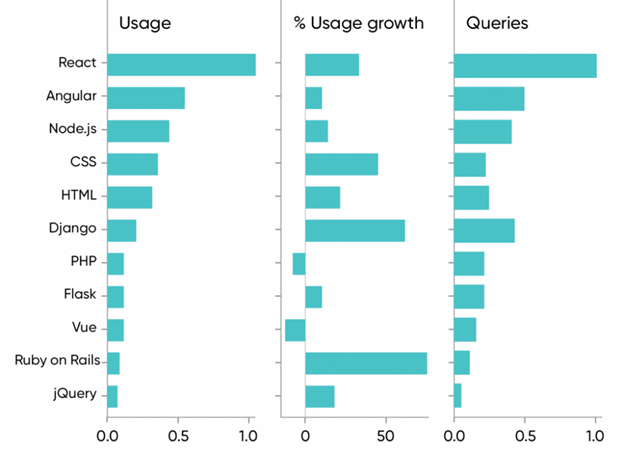
In a recent O’Reilly’s report, the React library dominates usage while also continuing to post strong growth at 34 percent year-on-year.
Future-proof Impact
- Write code once and deploy across many platforms, like Android, iOS, and the web
- Keep your app easy to understand and extend as it grows
- Integrate components with any existing code
- Ideal for modern web development and native- rendered apps for Android and iOS devices.
Technology Stacks Compatibility & Tooling Support
React enjoys first-grade support from all the major technology stacks. Microsoft for instance has built in ample integration points all along the software dev cycle for on-premises as well as for cloud technologies. Visual Studio/Code as well as the various Azure service support React. For e.g., Office UI, the latest Power Platform have solid support for React and it is only growing.
The integration with PowerApps is an interesting thing to follow. It provides a nice way to blend in two different programming paradigms, the modern approach along with the Low-Code/No-Code approach.
The Conclusion
Frameworks have their own significance and there is no undermining the same, libraries like React though could be instrumental with quick turnarounds for prototyping, and application migrations as well as upgrades. The prototypes can of course be developed into full-fledged applications later, and the upgrades/migrations can be done in a hybrid or co-existence manner with the current apps. Being lightweight and flexible are two other capabilities that are generally in favor of React.
Although, at the end project specifications, an architects/developer’s preferences, and overall business requirements play an equally if not more important role in the technology stack finalization.
You don’t need a framework. You need a painting, not a frame. – Klaus Kinski
 WePlus Consultancy